
Jantar Mantar: A Marvel of India's Astronomical Heritage
Discover the history, architecture, and scientific significance of Jantar Mantar, one of India's greatest astronomical observatories and a UNESCO World Heritage Site.
Introduction
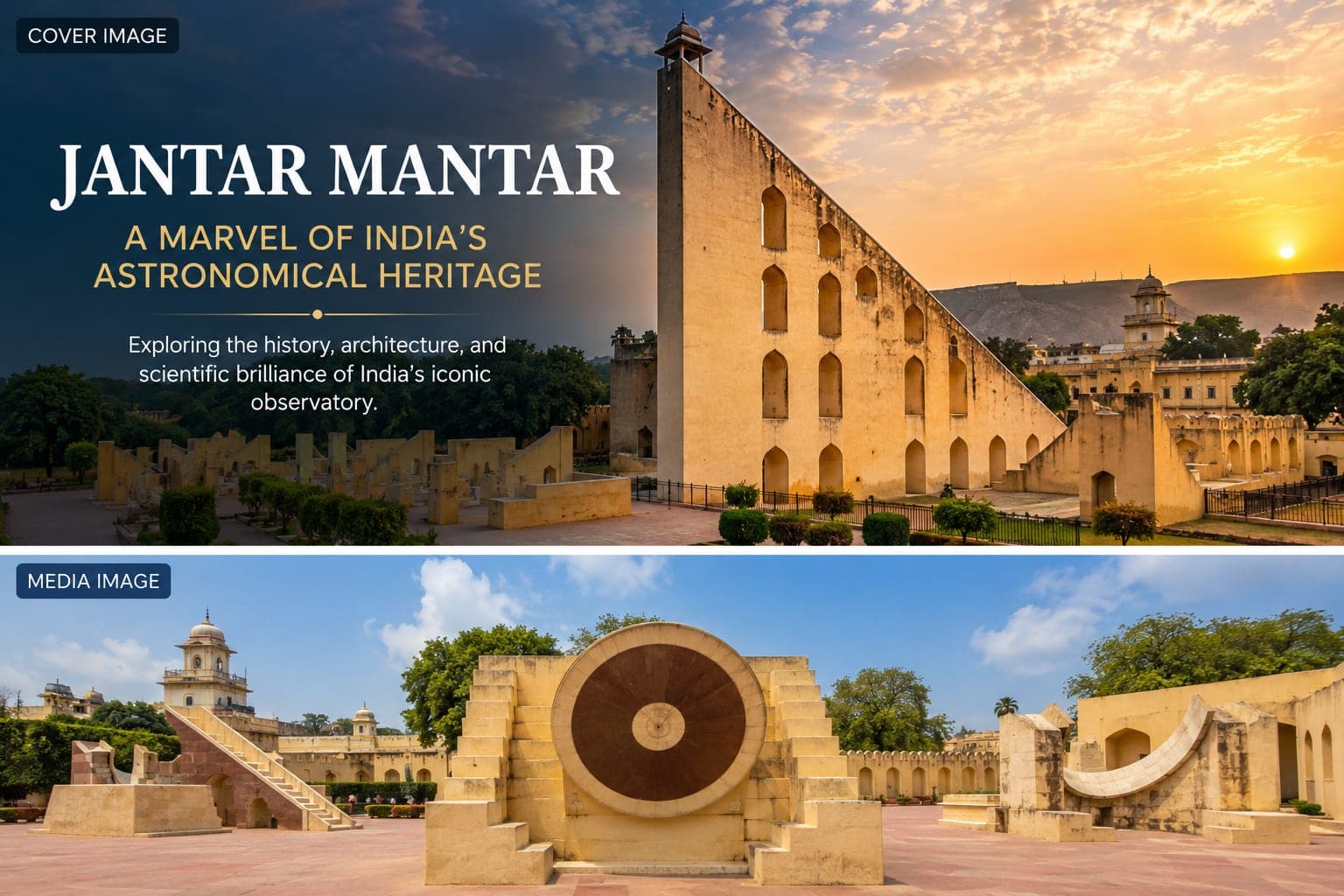
Jantar Mantar is one of India's most significant historical and scientific landmarks. Built in the early 18th century by Maharaja Sawai Jai Singh II, it was designed to observe celestial bodies, measure time, predict eclipses, and study the movement of planets and stars. Among the five observatories built by the king across India, the Jantar Mantar in Jaipur is the largest and best preserved. It has been recognized as a UNESCO World Heritage Site for its exceptional cultural and scientific value.
History
Maharaja Sawai Jai Singh II was a passionate scholar of astronomy and mathematics. Dissatisfied with the accuracy of existing astronomical tables, he commissioned the construction of five observatories between 1724 and 1735 in Delhi, Jaipur, Ujjain, Mathura, and Varanasi. These observatories were equipped with large masonry instruments that provided highly accurate astronomical measurements without the use of telescopes.
Architecture and Instruments
Jantar Mantar is famous for its massive geometric structures, each designed for a specific astronomical purpose. Some of the most notable instruments include:
Samrat Yantra: The world's largest stone sundial, capable of measuring time with remarkable precision.
Jai Prakash Yantra: Used to determine the position of celestial objects and study astronomical coordinates.
Ram Yantra: Measures the altitude and azimuth of celestial bodies.
Misra Yantra: Designed to determine the shortest and longest days of the year and compare local time with that of other cities.
These instruments demonstrate the advanced scientific understanding and engineering skills of ancient Indian astronomers.
Scientific Importance
Jantar Mantar played a vital role in improving astronomical calculations during its time. It helped scholars create accurate calendars, predict eclipses, and understand planetary movements. The observatory reflects the strong connection between astronomy, mathematics, and architecture in Indian scientific traditions.
UNESCO World Heritage Site
In 2010, the Jaipur Jantar Mantar was designated as a UNESCO World Heritage Site. The observatory is recognized for its outstanding universal value as an exceptional example of astronomical observation and architectural innovation. It continues to attract researchers, historians, and tourists from around the world.
Visitor Experience
Today, Jantar Mantar is one of Jaipur's most visited attractions. Visitors can explore its enormous instruments, learn about ancient astronomical techniques, and admire the ingenuity of its design. Guided tours and educational programs help visitors understand the scientific principles behind each structure.
Conclusion
Jantar Mantar stands as a remarkable testament to India's rich scientific and cultural heritage. Its innovative astronomical instruments, architectural brilliance, and historical significance make it one of the world's most extraordinary observatories. Whether you are interested in history, science, or architecture, Jantar Mantar offers a fascinating glimpse into the achievements of ancient Indian astronomy.
Gallery

The Morning Dispatch
Join 500,000+ readers who start their day with essential global insights — politics, markets, tech, and culture.
Free forever. Unsubscribe anytime.
Related Stories


Reader Comments (1)
Join the discussion. Share your perspective with our community.
shyam
Good job daniyal